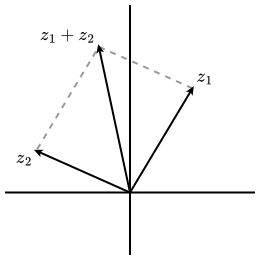
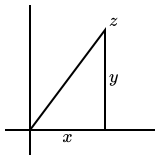
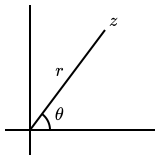
Although we just introduced a new way of writing complex numbers, let’s for a moment return to the \((x,y)\)-notation. It suggests that we can think of a complex number as a two-dimensional real vector. When plotting these vectors in the plane \(\R^2\text{,}\) we will call the \(x\)-axis the real axis and the \(y\)-axis the imaginary axis. The addition that we defined for complex numbers resembles vector addition; see Figure 1.2.1. The analogy stops at multiplication: there is no “usual” multiplication of two vectors in \(\R^2\) that gives another vector, and certainly not one that agrees with our definition of the product of two complex numbers.
Any vector in \(\R^2\) is defined by its two coordinates. On the other hand, it is also determined by its length and the angle it encloses with, say, the positive real axis; let’s define these concepts thoroughly.
A given complex number \(z = x+iy\) has infinitely many possible arguments. For instance, the number \(1 = 1 + 0i\) lies on the positive real axis, and so has argument \(0\text{,}\) but we could just as well say it has argument \(2\pi\text{,}\)\(4\pi\text{,}\)\(-2\pi\text{,}\) or \(2\pi k\) for any integer \(k\text{.}\) The number \(0 = 0+0i\) has modulus \(0\text{,}\) and every real number \(\phi\) is an argument. Aside from the exceptional case of \(0\text{,}\) for any complex number \(z\text{,}\) the arguments of \(z\) all differ by a multiple of \(2\pi\text{,}\) just as we saw for the example \(z = 1\text{.}\)
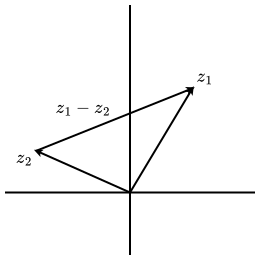
Let \(z_1, z_2 \in \C\) be two complex numbers, thought of as vectors in \(\R^2\text{,}\) and let \(d(z_1,z_2)\) denote the distance between (the endpoints of) the two vectors in \(\R^2\) (see Figure 1.2.4). Then
This is the definition of \(|z_1 - z_2|\text{.}\) Since \((x_1 - x_2)^2 = (x_2 - x_1)^2\) and \((y_1 - y_2)^2
= (y_2 - y_1)^2\text{,}\) this is also equal to \(|z_2 - z_1|\text{.}\)
That \(|z_1 - z_2| = |z_2 - z_1|\) simply says that the vector from \(z_1\) to \(z_2\) has the same length as the vector from \(z_2\) to \(z_1\text{.}\)
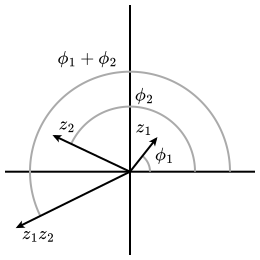
One reason to introduce the absolute value and argument of a complex number is that they allow us to give a geometric interpretation for the multiplication of two complex numbers. Let’s say we have two complex numbers: \(x_1 + i y_1\text{,}\) with absolute value \(r_1\) and argument \(\phi_1\text{,}\) and \(x_2 + i y_2\text{,}\) with absolute value \(r_2\) and argument \(\phi_2\text{.}\) This means we can write \(x_1 + i y_1 = ( r_1 \cos \phi_1 ) + i (
r_1 \sin \phi_1 )\) and \(x_2 + i y_2 = ( r_2 \cos \phi_2 ) + i
( r_2 \sin \phi_2 )\text{.}\) To compute the product, we make use of some classic trigonometric identities:
So the absolute value of the product is \(r_1 r_2\) and one of its arguments is \(\phi_1 + \phi_2\text{.}\) Geometrically, we are multiplying the lengths of the two vectors representing our two complex numbers and adding their angles measured with respect to the positive real axis. 1
You should convince yourself that there is no problem with the fact that there are many possible arguments for complex numbers, as both cosine and sine are periodic functions with period \(2\pi\text{.}\)
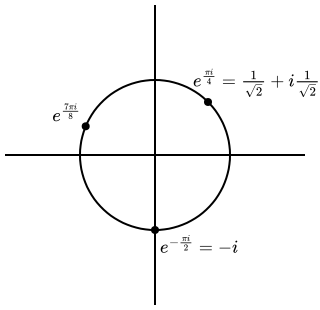
In view of the above calculation, it should come as no surprise that we will have to deal with quantities of the form \(\cos \phi + i \sin \phi\) (where \(\phi\) is some real number) quite a bit. To save space, bytes, ink, etc., we introduce a shortcut notation and define
\begin{equation*}
e^{ i \phi } \ := \ \cos \phi + i \sin \phi \,\text{.}
\end{equation*}
At this point, this exponential notation is indeed purely a notation. 2
In particular, while our notation “proves” Euler’s formula\(e^{ 2 \pi i } = 1\text{,}\) this simply follows from the facts \(\sin(2 \pi) = 0\) and \(\cos(2 \pi) = 1\text{.}\) The connection between the numbers \(\pi\text{,}\)\(i\text{,}\)\(1\text{,}\) and the complex exponential function (and thus the number \(e\)) is somewhat deeper. We’ll explore this in Section 3.5.
We will later see in Chapter 3 that it has an intimate connection to the complex exponential function. For now, we motivate this maybe strange seeming definition by collecting some of its properties:
Proposition 1.2.7 implies that \(( e^{ 2 \pi i \frac m n } )^n = 1\) for any integers \(m\) and \(n > 0\text{.}\) Thus numbers of the form \(e^{ 2 \pi i q }\) with \(q \in \Q\) play a pivotal role in solving equations of the form \(z^n = 1\text{,}\) which is reason to give them a special name.
A root of unity is a number of the form \(e^{ 2 \pi i \frac m n }\) for some integers \(m\) and \(n > 0\text{.}\) Equivalently (by Exercise 1.5.17), a root of unity is a complex number \(\zeta\) such that \(\zeta^n = 1\) for some positive integer \(n\text{.}\) In this case, we call \(\zeta\) an \(n\th\) root of unity. If \(n\) is the smallest positive integer with the property \(\zeta^n = 1\text{,}\) then \(\zeta\) is a primitive \(n\th\) root of unity.
We now have five different ways of thinking about a complex number: the formal definition, in rectangular form, in polar form, and geometrically, using Cartesian coordinates or polar coordinates. Each of these ways is useful in different situations, and translating between them is an essential ingredient in complex analysis. This list is not exhaustive; see, e.g., Exercise 1.5.21.