Looking back to what machinery we have established so far for integrating complex functions, there are several useful theorems we developed in Chapter 4 and Chapter 5. But there are some simple-looking integrals, such as
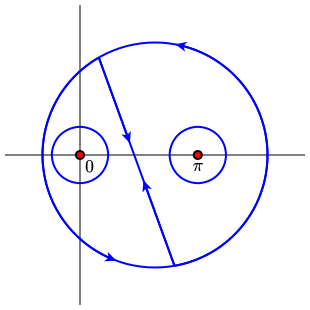
The problems, naturally, comes from the singularities at 0 and \(\pi\) inside the integration path, which in turn stem from the roots of the sine function. We might try to simplify this problem a bit by writing the integral as the sum of integrals over the two “D” shaped paths shown in Figure 5.1.4 (the integrals along the common straight line segments cancel). Furthermore, by Cauchy’s Theorem 4.3.4, we may replace these integrals with integrals over small circles around \(0\) and \(\pi\text{.}\) This transforms (7.1) into a sum of two integrals, which we are no closer to being able to compute; however, we have localized the problem, in the sense that we now “only” have to compute integrals around one of the singularities of our integrand.
This motivates developing techniques to approximate complex functions locally, in analogy with the development of Taylor series in calculus. It is clear that we need to go further here, as we’d like to have such approximations near a singularity of a function. At any rate, to get any of this started, we need to talk about sequences and series of complex numbers and functions, and this chapter develops them.