Logo image

A First Course in Complex Analysis

Section 9.2 Residues

We now pick up the thread from Corollary 8.3.9 and apply it to the Laurent series
\begin{equation*} f(z) \ = \ \sz c_k \left( z - z_0 \right)^k \end{equation*}
at an isolated singularity \(z_0\) of \(f\text{.}\) It says that if \(\gg\) is any positively oriented, simple, closed, piecewise smooth path in the punctured disk of convergence of this Laurent series, and \(z_0\) is inside \(\gg\text{,}\) then
\begin{equation*} \int_\gg f(z) \, \diff{z} \ = \ 2 \pi i \, c_{ -1 } \,\text{.} \end{equation*}

Definition 9.2.1.

Suppose \(z_0\) is an isolated singularity of \(f\) with Laurent series \(\sz c_k (z - z_0)^k\text{.}\) Then \(c_{-1}\) is the residue of \(f\) at \(z_0\), denoted by \(\Res_{z=z_0} (f(z))\) or \(\Res (f(z) , \, z=z_0)\text{.}\)
Corollary 8.3.9 suggests that we can compute integrals over closed curves by finding the residues at isolated singularities, and our next theorem makes this precise.

Proof.

First, let \(S\) be the set of singularities inside \(\gg\text{.}\) The set \(S\) is closed (since the points in \(G\) where \(f\) is holomorphic form an open set) and bounded (since the inside of \(\gg\) is bounded), and the points of \(S\) are isolated in \(S\) (by Theorem 8.2.1(b)). An application of Exercise 9.4.22 shows that \(S\) is finite.
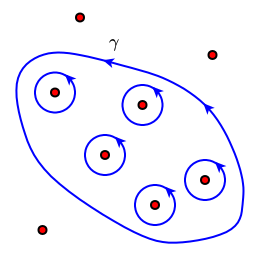
Now we follow the approach started in Figure 7.0.1 as with that integration path, we “subdivide” \(\gg\) so that we can replace it by closed curves around the singularities inside \(\gg\text{.}\) These curves, in turn, can then be transformed to circles around the singularities, as suggested by Figure 9.2.3. By Cauchy’s Theorem 4.3.4, \(\int_\gg f\) equals the sum of the integrals of \(f\) over these circles. Now use Corollary 8.3.9.
Figure 9.2.3. Proof of Theorem 9.2.2.
Computing integrals is as easy (or hard!) as computing residues. The following two propositions start the range of tricks you may use when computing residues.

Proof.

  1. This follows from Proposition 9.1.10(a).
  2. We know by Proposition 9.1.10(b) that the Laurent series at \(z_0\) looks like
    \begin{equation*} f(z) = \sum_{k \geq -n} c_k (z-z_0)^k\text{.} \end{equation*}
    But then
    \begin{equation*} (z - z_0)^n f(z) = \sum_{k \geq -n} c_k (z-z_0)^{k+n} \end{equation*}
    is a power series, and we can use Taylor’s formula (Corollary 8.1.5) to compute \(c_{-1}\text{.}\)
It is worth noting that we are really coming full circle here: compare this proposition to Cauchy’s Integral Formulas (Theorem 4.4.5, Theorem 5.1.1, and Corollary 8.1.12).
Example 9.2.5.

The integrand \(\frac{ \exp(z) }{ \sin(z) }\) in Example 8.3.10 has poles of order 1 at 0 and \(\pi\text{.}\) We thus compute
\begin{equation*} \Res_{ z=0 } \left( \frac{ \exp(z) }{ \sin(z) } \right) \ = \ \lim_{ z \to 0 } \left( z \, \frac{ \exp(z) }{ \sin(z) } \right) \ = \ \exp(0) \lim_{ z \to 0 } \frac{ z }{ \sin(z) } \ = \ 1 \end{equation*}
and
\begin{align*} \Res_{ z=\pi } \left( \frac{ \exp(z) }{ \sin(z) } \right) \amp \ = \ \lim_{ z \to \pi } \left( (z-\pi) \, \frac{ \exp(z) }{ \sin(z) } \right)\\ \amp \ = \ \exp(\pi) \lim_{ z \to \pi } \frac{ z-\pi }{ \sin(z) }\\ \amp \ = \ - e^\pi\text{,} \end{align*}
confirming our computations in Example 8.3.10.

Example 9.2.6.

Revisiting Example 9.1.11, the function \(f(z) = \frac{ \sin(z) }{ z^3 }\) has a double pole at 0 with
\begin{align*} \Res_{ z=0 } \left( \frac{ \sin(z) }{ z^3 } \right) \amp \ = \ \lim_{ z \to 0 } \frac{ d }{ \diff{z} } \left( z^2 \, \frac{ \sin(z) }{ z^3 } \right)\\ \amp \ = \ \lim_{ z \to 0 } \left( \frac{ z \cos(z) - \sin(z) }{ z^2 } \right)\\ \amp \ = \ 0 \,\text{,} \end{align*}
after a few iterations of L’Hôpital’s Rule. (In this case, it is simpler to read the residue off the Laurent series in Example 9.1.11.)

Proof.

The functions \(f\) and \(g\) have power series centered at \(z_0\text{;}\) the one for \(g\) has by assumption no constant term:
\begin{align*} f(z) \amp \ = \ \sum_{k \ge 0} a_k (z-z_0)^k\\ g(z) \amp \ = \ \sum_{k \ge 1} b_k (z-z_0)^k \ = \ (z-z_0) \sum_{k \geq 1} b_k (z-z_0)^{k-1} \text{.} \end{align*}
Let \(\ds h(z) := \sum_{k \geq 1} b_k (z-z_0)^{k-1}\) and note that \(h(z_0) = b_1 \ne 0\text{.}\) Hence
\begin{equation*} \frac{ f(z) }{ g(z) } \ = \ \frac{ f(z) }{ (z-z_0) \, h(z) } \,\text{,} \end{equation*}
and the function \(\frac f h\) is holomorphic at \(z_0\text{.}\) By Proposition 9.2.4 and Taylor’s formula (Corollary 8.1.5,
\begin{align*} \Res_{z=z_0} \left( \frac{ f(z) }{ g(z) } \right) \amp \ = \ \lim_{z\to z_0}\left( (z-z_0) \frac{f(z)}{(z-z_0)h(z)}\right)\\ \amp \ = \ \frac{ f(z_0) }{ h(z_0) }\\ \amp \ = \ \frac{ a_0 }{ b_1 }\\ \amp \ = \ \frac{ f(z_0) }{ g'(z_0) } \,\text{.} \end{align*}

Example 9.2.8.

Revisiting once more Example 8.3.10, we note that \(f(z) = \exp(z)\) and \(g(z) = \sin(z)\) fit the bill. Thus
\begin{equation*} \Res_{ z=0 } \left( \frac{ \exp(z) }{ \sin(z) } \right) \ = \ \frac{ \exp(0) }{ \cos(0) } \ = \ 1 \end{equation*}
and
\begin{equation*} \Res_{ z=\pi } \left( \frac{ \exp(z) }{ \sin(z) } \right) \ = \ \frac{ \exp(\pi) }{ \cos(\pi) } \ = \ - e^\pi \text{,} \end{equation*}
confirming once more our computations in Example 8.3.10 and Example 9.2.5.

Example 9.2.9.

We compute the residue of \(\frac{ z^2 + 2 }{ (\exp(z) - 1) \cos(z) }\) at \(z_0 = 2 \pi i\text{,}\) by applying Proposition 9.2.7 with \(f(z) = \frac{ z^2 + 2 }{ \cos(z) }\) and \(g(z) = \exp(z) - 1\text{.}\) Thus
\begin{equation*} \Res_{ z = 2 \pi i } \left( \frac{ z^2 + 2 }{ (\exp(z) - 1) \cos(z) } \right) \ = \ \frac{ \frac{ (2 \pi i)^2 + 2 }{ \cos(2 \pi i) } }{ \exp(2 \pi i) } \ = \ \frac{ -4 \pi^2 + 2 }{ \cosh(2 \pi) } \, \text{.} \end{equation*}
An extension of Proposition 9.2.7 of sorts is given in Exercise 9.4.11.