Logo image

A First Course in Complex Analysis

Exercises 7.5 Exercises

1.

For each of the sequences, prove convergence or divergence. If the sequence converges, find the limit.

(d)

\(a_n = 2 - \frac{ i \, n^2 }{ 2n^2 + 1 }\)
Answer.
convergent (limit \(2-\frac i2\))

(e)

\(a_n =\sin ( \frac 1 n )\)
Answer.
convergent (limit \(0\))

2.

Determine whether each of the following series converges or diverges.

(a)

\(\ds \sum_{n \geq 1} \left(\frac{1+i}{\sqrt{3}}\right)^n\)

(b)

\(\ds \sum_{n \geq 1} n\left(\frac{1}{i}\right)^n\)

(c)

\(\ds \sum_{n \geq 1} \left(\frac{1+2i}{\sqrt{5}}\right)^n\)

(d)

\(\ds \sum_{n \geq 1} \frac{1}{n^3+i^n}\)

3.

Compute \(\ds \sum_{n \geq 1} \frac 1 { n^2 + 2n } \text{.}\)
Answer.
\(\frac23\)

5.

Prove the following:

(a)

\(\displaystyle \lim_{ n \to \infty } a_n = a \Longrightarrow \lim_{ n \to \infty } |a_n| = |a|\text{.}\)

(b)

\(\displaystyle \lim_{ n \to \infty } a_n = 0 \Longleftrightarrow \lim_{ n \to \infty } |a_n| = 0\text{.}\)

6.

Show that a convergent sequence is bounded, i.e.: if \(\lim_{ n \to \infty } a_n\) exists, then there is an \(M\) such that \(|a_n| \le M\) for all \(n \ge 1\text{.}\)

7.

Show that the limit of a convergent sequence is unique.

8.

Let \((a_n)\) be a sequence. A point \(a\) is an accumulation point of the sequence if for every \(\epsilon > 0\) and every \(N \in \Z_{ >0 }\) there exists some \(n > N\) such that \(|a_n - a| \lt \epsilon\text{.}\) Prove that if a sequence has more than one accumulation point then the sequence diverges.

9.

(a)

Show that \(\frac 1 {k!} \le \frac 3 {k(k+1)}\) for any positive integer \(k\text{.}\)

(b)

Conclude with Example 7.2.3 that for any positive integer \(n\text{,}\)
\begin{equation*} 1 + \frac 1 2 + \frac 1 6 + \dots + \frac 1 {n!} \ \le \ 3 \,\text{.} \end{equation*}

10.

Derive the Archimedean Property from the Monotone Sequence Property.

12.

Prove that \(\left( c_n \right)\) converges if and only if \(\left( \Re c_n \right)\) and \(\left( \Im c_n \right)\) converge.

13.

Prove that \(\Z\) is complete and that \(\Q\) is not complete.

14.

Prove that, if \(a_n \leq b_n \leq c_n\) for all \(n\) and \(\lim_{n \to \infty} a_n = \lim_{n \to \infty} c_n = L\text{,}\) then \(\lim_{n \to \infty} b_n = L\text{.}\) This is called the Squeeze Theorem, and is useful in testing a sequence for convergence.

15.

Find the least upper bound of the set \(\left\{ \Re \left( e^{2 \pi i t} \right) : \, t \in \Q \setminus \Z \right\}\text{.}\)

16.

(a)

Suppose that the sequence \((c_n)\) converges to zero. Show that \(\sum_{n \ge 0} c_n\) converges if and only if \(\sum_{k \ge 0} (c_{2k}+c_{2k+1})\) converges. Moreover, if the two series converge then they have the same limit.

(b)

Give an example where \((c_n)\) does not converge to \(0\) and one of the series in (a) diverges while the other converges.

17.

Prove that the series \(\ds \sum_{k \geq 1} b_k\) converges if and only if \(\ds \lim_{n \to \infty} \sum_{k \ge n} b_k = 0 \, \text{.}\)

18.

(a)

Show that \(\ds \sum_{k \geq 1} \frac k {k^2+1}\) diverges.

(b)

Show that \(\ds \sum_{k \geq 1} \frac k {k^3+1}\) converges.

19.

(a)

Suppose \(G\subseteq\C\) and \(f_n : G \to \C\) for \(n \ge 1\text{.}\) Suppose \((a_n)\) is a sequence in \(\R\) with \(\lim_{ n \to \infty } a_n = 0\) and, for each \(n \ge 1\text{,}\)
\begin{equation*} |f_n(z)| \ \le \ a_n \qquad \text{ for all } z \in G \,\text{.} \end{equation*}
Show that \((f_n)\) converges uniformly to the zero function in \(G\text{.}\)

20.

(a)

Suppose \(G\subseteq\C\text{,}\) \(f_n : G \to \C\) for \(n \ge 1\text{,}\) and \((f_n)\) converges uniformly to the zero function in \(G\text{.}\) Show that, if \((z_n)\) is any sequence in \(G\text{,}\) then
\begin{equation*} \lim_{ n \to \infty } f_n(z_n) \ = \ 0 \,\text{.} \end{equation*}

(b)

Apply a) to the function sequence given in Example 7.3.2, together with the sequence \((z_n = e^{ - \frac 1 n })\text{,}\) to prove that the convergence given in Example 7.3.2 is not uniform.

21.

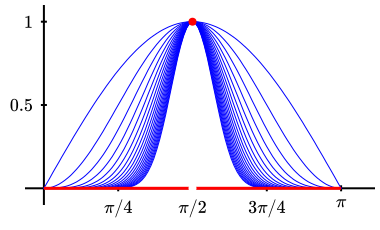
Consider \(f_n : [0,\pi] \to \R\) given by \(f_n(x) = \sin^n(x)\text{,}\) for \(n \ge 1\text{.}\) Prove that \((f_n)\) converges pointwise to \(f: [0,\pi] \to \R\) given by
\begin{equation*} f(x) = \begin{cases}1 \amp \text{ if } x = \frac \pi 2 \, , \\ 0 \amp \text{ if } x \ne \frac \pi 2 \, , \end{cases} \end{equation*}
yet this convergence is not uniform. (See Figure 7.5.1.)
Figure 7.5.1. The functions \(f_n(x) := \sin^n(x)\) in Exercise 7.5.21.

22.

Where do the following sequences converge pointwise? Do they converge uniformly on this domain?

(a)

\(\left( n \, z^n \right)\)

(b)

\(\left( \frac{ z^n }{n} \right)\)

(c)

\(\left( \frac 1 {1+nz} \right)\) where \(\Re(z) \geq 0\)

23.

Let \(f_n(x)=n^2x \, e^{-nx}\text{.}\)

(a)

Show that \(\lim_{n\to\infty}f_n(x)=0\) for all \(x\ge0\text{.}\)
Hint.
Treat \(x=0\) as a special case; for \(x>0\) you can use L’Hôpital’s rule (Theorem A.0.11) — but remember that \(n\) is the variable, not \(x\text{.}\)

(b)

Find \(\lim_{n\to\infty}\int_0^1 f_n(x)\,\diff{x}\text{.}\)
Hint.
The answer is not \(0\text{.}\)

24.

The product of two power series centered at \(z_0\) is another power series centered at \(z_0\text{.}\) Derive a formula for its coefficients in terms of the coefficients of the original two power series.

25.

Find a power series (and determine its radius of convergence) for the following functions.

(a)

\(\ds \frac{ 1 }{ 1 + 4 z }\)
Answer.
\(\sum_{k \geq 0} (-4)^k \, z^k\)

(b)

\(\ds \frac{ 1 }{ 3 - \frac z 2 }\)
Answer.
\(\sum_{k \geq 0} \frac 1 { 3 \cdot 6^k } \, z^k\)

(c)

\(\ds \frac{z^2}{(4-z)^2}\)
Answer.
\(\s \frac{ k+1 }{ 2 \cdot 4^k } \, z^{ k+2 }\)

26.

Find a power series representation about the origin of each of the following functions.

(a)

\(\cos z\)
Answer.
\(\s \frac{ (-1)^k }{ (2k)! } \, z^{ 2k }\)

(b)

\(\cos(z^2)\)
Answer.
\(\s \frac{ (-1)^k }{ (2k)! } \, z^{ 4k }\)

(c)

\(z^2\sin z\)
Answer.
\(\s \frac{ (-1)^k }{ (2k+1)! } \, z^{ 2k+3 }\)

(d)

\((\sin z)^2\)
Answer.
\(\sum_{ k \ge 1 } \frac{ (-1)^{ k+1 } 2^{ 2k-1 } }{ (2k)! } \, z^{ 2k }\)

27.

(a)

Suppose that the sequence \((c_k)\) is bounded. Show that the radius of convergence of \(\sum_{k\ge0}c_k(z-z_0)^k\) is at least \(1\text{.}\)

(b)

Suppose that the sequence \((c_k)\) does not converge to \(0\text{.}\) Show that the radius of convergence of \(\sum_{k\ge0}c_k(z-z_0)^k\) is at most \(1\text{.}\)

28.

Find the power series centered at 1 and compute its radius of convergence for each of the following functions:

(a)

\(f(z)= \frac 1 z\)
Answer.
\(\sum_{k \geq 0} (-1)^k \, (z-1)^k\)

(b)

\(f(z)=\Log (z)\)
Answer.
\(\sum_{k \geq 1} \frac {(-1)^{k-1}} k (z-1)^k\)

29.

Use the Weierstraß \(M\)-test to show that each of the following series converges uniformly on the given domain:

(a)

\(\displaystyle \sum_{k\ge1}\frac{z^k}{k^2}\) on \(\overline D[0,1]\)

(b)

\(\displaystyle \sum_{k\ge0}\frac1{z^k}\) on \(\{ z \in \C : \, \abs{z}\ge2 \}\)

(c)

\(\displaystyle \sum_{k\ge0}\frac{z^k}{z^k+1}\) on \(\displaystyle \overline D[0,r]\) where \(0\le r\lt 1\)

30.

Fix \(z \in \C\) and \(r > |z|\text{.}\) Prove that \(\ds \s \left( \frac z w \right)^k\) converges uniformly in the variable \(w\) for \(|w| \ge r\text{.}\)

32.

Prove that, if \(\lim_{ k \to \infty } \left| \frac{ c_{ k+1 } }{ c_{ k } } \right|\) exists then the radius of convergence of \(\s c_k ( z - z_0)^k\) equals
\begin{equation*} R = \begin{cases}\infty \amp \text{ if } \lim_{ k \to \infty } \left| \frac{ c_{ k+1 } }{ c_{ k } } \right| = 0 \, , \\ \lim_{ k \to \infty } \left| \frac{ c_{ k } }{ c_{ k+1 } } \right| \amp \text{ otherwise. } \end{cases} \end{equation*}
33.

Find the radius of convergence for each of the following series.

(a)

\(\displaystyle \sum_{k \geq 0} a^{ k^2 } z^k\) where \(a \in \C\)
Answer.
\(\infty\)

(b)

\(\displaystyle \sum_{k \geq 0} k^n z^k\) where \(n \in \Z\)
Answer.
\(1\)

(d)

\(\displaystyle \sum_{k \geq 1} \frac{ (-1)^k }{ k } \, z^{ k(k+1) }\)
Answer.
\(1\)

(e)

\(\displaystyle \sum_{k\ge1}\frac{z^k}{k^k}\)

(f)

\(\displaystyle \sum_{k\ge0}\cos(k) z^k\)

(g)

\(\displaystyle \sum_{k\ge0}4^k(z-2)^k\)

34.

Find a function representing each of the following series.

(a)

\(\displaystyle \sum_{k \geq 0} \frac{z^{2k}}{k!}\)
Answer.
\(\exp(z^2)\)

(b)

\(\displaystyle \sum_{k \geq 1} k \, (z-1)^{k-1}\)
Answer.
\(\frac1{(2-z)^2}\)

(c)

\(\displaystyle \sum_{k \geq 2} k(k-1) \, z^k\)
Answer.
\(\frac{2z^2}{(2-z)^2}\)

35.

Recall the function \(f : D[0,1] \to \C\) defined in Exercise 5.4.5 through
\begin{equation*} f(z) := \int_{ [0,1] } \frac{ \diff{w} }{ 1-wz } \,\text{.} \end{equation*}
Find a power series for \(f\text{.}\)

36.

Define the functions \(f_n : \R_{ \ge 0 } \to \R\) via \(f_n(t)= \frac 1 n \, e^{- \frac t n}\text{,}\) for \(n \ge 1\text{.}\)

(a)

Show that the maximum of \(f_n(t)\) is \(\frac 1 n\text{.}\)

(b)

Show that \(f_n(t)\) converges uniformly to the zero function on \(\R_{ \ge 0 }\text{.}\)

(c)

Show that \(\int_0^\infty f_n(t)\,\diff{t}\) does not converge to \(0\) as \(n\to\infty\text{.}\)