To define the complex exponential function, we once more borrow concepts from calculus, namely the real exponential function 1
How to define the real exponential function is a nontrivial question. Our preferred way to do this is through a power series: \(e^x = \sum_{k \geq 0} \frac 1 {k!} x^k\text{.}\) In light of this definition, you might think we should have simply defined the complex exponential function through a complex power series. In fact, this is possible (and an elegant definition); however, one of the promises of this book is to introduce complex power series as late as possible. We agree with those readers who think that we are cheating at this point, as we borrow the concept of a (real) power series to define the real exponential function.
and the real sine and cosine, and we finally make sense of the notation \(e^{it} = \cos t + i
\sin t\text{.}\)
This definition seems a bit arbitrary. Our first justification is that all exponential rules that we are used to from real numbers carry over to the complex case. They mainly follow from Proposition 1.2.7 and are collected in the following.
Item (c) is very special and has no counterpart for the real exponential function. It says that the complex exponential function is periodic with period \(2 \pi i\text{.}\) This has many interesting consequences; one that may not seem too pleasant at first sight is the fact that the complex exponential function is not one-to-one.
Item (f) is not only remarkable, but we invite you to meditate on its proof below; it gives a strong indication that our definition of \(\exp\) is reasonable. We also note that (f) implies that \(\exp\) is entire.
(f) The partial derivatives of \(f(z) = \exp(z)\) are
\begin{equation*}
\fderiv fx \ = \ e^x \left( \cos y + i \sin y \right) \qquad
\text{ and } \qquad \fderiv fy \ = \ e^x \left( -\sin y + i \cos
y \right) \text{.}
\end{equation*}
They are continuous in \(\C\) and satisfy the Cauchy–Riemann equation (2.2):
We should make sure that the complex exponential function specializes to the real exponential function for real arguments: indeed, if \(z = x \in \R\) then
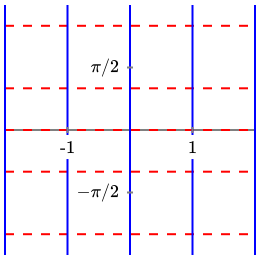
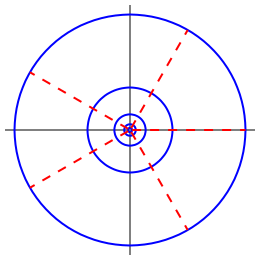
Figure3.4.3.The domain of the complex exponential function is shown on the left and the codomain on the right. The function maps the blue vertical lines on the left into circles on the right and maps the red dashed horizontal lines on the left into the rays on the right.
The trigonometric functions—sine, cosine, tangent, cotangent, etc.—also have complex analogues; however, they do not play the same prominent role as in the real case. In fact, we can define them as merely being special combinations of the exponential function.
Note that to write tangent and cotangent in terms of the exponential function, we used the fact that \(\exp(z) \exp(-z) = \exp(0) = 1\text{.}\) Because \(\exp\) is entire, so are \(\sin\) and \(\cos\text{.}\)
Finally, one word of caution: unlike in the real case, the complex sine and cosine are not bounded—consider, for example, \(\sin (iy)\) as \(y \to \pm \infty\text{.}\)
As such, they are yet more special combinations of the exponential function. They still satisfy the identities you already know, e.g.,
\begin{equation*}
\frac{d}{\diff{z}} \sinh z \ = \ \cosh z \qquad \text{ and }
\qquad \frac{d}{\diff{z}} \cosh z \ = \ \sinh z \, \text{.}
\end{equation*}
Moreover, they are related to the trigonometric functions via
\begin{equation*}
\sinh (iz) \ = \ i \sin z \qquad \text{ and } \qquad \cosh (iz) \ = \
\cos z \, \text{.}
\end{equation*}