Suppose \(\gg_0\) and \(\gg_1\) are closed paths in the region \(G \subseteq \C\text{,}\) parametrized by \(\gg_0(t), \ 0 \leq t \leq 1\text{,}\) and \(\gg_1(t), \ 0 \leq t \leq 1\text{,}\) respectively. Then \(\gg_0\) is \(G\)-homotopic to \(\gg_1\) if there exists a continuous function \(h :
[0,1]^2 \to G\) such that, for all \(s,\,t\in[0,1]\text{,}\)
The function \(h(t,s)\) is called a homotopy. For each fixed \(s\text{,}\) a homotopy \(h(t,s)\) is a path parametrized by \(t\text{,}\) and as \(s\) goes from \(0\) to \(1\text{,}\) these paths continuously transform from \(\gg_0\) to \(\gg_1\text{.}\) The last condition in (4.3) simply says that each of these paths is also closed.
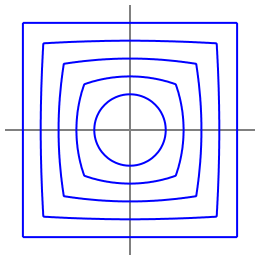
Figure 4.3.3 attempts to illustrate that the unit circle is \((\C \setminus \{ 0 \})\)-homotopic to the square with vertices \(\pm 3 \pm 3i\text{.}\) Indeed, you should check (Exercise 4.5.20) that
\begin{equation}
h(t,s) \ := \ (1-s) e^{ 2 \pi i t } + 3s \times
\begin{cases} 1 + 8it \amp \text{ if } 0 \le t \le \frac 1
8 \, , \\ 2-8t + i \amp \text{ if } \frac 1 8 \le t \le
\frac 3 8 \, , \\ -1 + 4i(1-2t) \amp \text{ if } \frac 3 8
\le t \le \frac 5 8 \, , \\ 8t-6 - i \amp \text{ if }
\frac 5 8 \le t \le \frac 7 8 \, , \\ 1 + 8i(t-1) \amp
\text{ if } \frac 7 8 \le t \le 1 \end{cases} \tag{4.4}
\end{equation}
gives a homotopy. Note that \(h(t,s) \ne 0\) for any \(0 \le t, s \le 1\) (hence “\((\C \setminus \{ 0 \})\)-homotopic”).
Exercise 4.5.23 shows that \(\sim_G\) is an equivalence relation on the set of closed paths in \(G\text{.}\) The definition of homotopy applies to parametrizations of curves; but Exercise 4.5.24, together with transitivity of \(\sim_G\text{,}\) shows that homotopy is invariant under reparametrizations.
Suppose \(G \subseteq \C\) is a region, \(f\) is holomorphic in \(G\text{,}\)\(\gg_0\) and \(\gg_1\) are piecewise smooth paths in \(G\text{,}\) and \(\gg_0 \sim_G \gg_1\text{.}\) Then
\begin{equation*}
\int_{\gg_0} f \ = \ \int_{\gg_1} f \,\text{.}
\end{equation*}
As a historical aside, it is assumed that Johann Carl Friedrich Gauß (1777–1855) knew a version of this theorem in 1811 but published it only in 1831. Cauchy (of Cauchy–Riemann equations fame) published his version in 1825, Karl Theodor Wilhelm Weierstraß (1815–1897) his in 1842. Theorem 4.3.4 is often called the Cauchy–Goursat Theorem, since Cauchy assumed that the derivative of \(f\) was continuous, a condition that was first removed by Edouard Jean-Baptiste Goursat (1858–1936).
where \(\gg\) is the square in Figure 4.3.3, oriented counter-clockwise. We could, of course, compute this integral by hand, but it is easier to apply Cauchy’s Theorem 4.3.4 to the function \(f(z) = \frac 1 z\text{,}\) which is holomorphic in \(G = \C \setminus \{ 0 \}\text{.}\) We showed in (4.4) that \(\gg\) is \(G\)-homotopic to the unit circle. Exercise 4.5.4 says that integrating \(f\) over the unit circle gives \(2
\pi i\) and so Cauchy’s Theorem 4.3.4 implies (4.5).
The full proof of Cauchy’s Theorem is beyond the scope of this book. However, there are several easier proofs under more restrictive hypotheses than Theorem 4.3.4. We shall present a proof under the following extra assumptions:
The derivative \(f'\) is continuous in \(G\text{.}\)
Technically, this is the assumption on \(h\text{:}\)
\begin{equation*}
h(t,s) = \begin{cases}h_1(t,s) \amp \text{ if } 0 \le t \le
t_1 \, , \\ h_2(t,s) \amp \text{ if } t_1 \le t \le t_2 \, ,
\\ \vdots \\ h_n(t,s) \amp \text{ if } t_{ n-1 } \le t \le 1
\, , \end{cases}
\end{equation*}
where each \(h_j(t,s)\) has continuous second partials 1
As we have seen with other “piecewise” definitions, the behavior of \(h\) at the subdivision lines \(t=t_i\) needs to be understood in terms of limits.
. (Example 4.3.2 gives one instance.) Now we turn to the proof under these extra assumptions.
For \(0 \leq s \leq 1\text{,}\) let \(\gg_s\) be the path parametrized by \(h(t,s), \ 0 \leq
t \leq 1\text{.}\) Consider the function \(I: [0,1] \to \C\) given by
so that \(I(0) = \int_{\gg_0} f\) and \(I(1) = \int_{\gg_1} f\text{.}\) We will show that \(I\) is constant; in particular, \(I(0) = I(1)\text{,}\) which proves the theorem. By Leibniz’s rule (Theorem A.0.9),
\begin{align*}
\frac{d}{\diff{s}} I(s) \ \amp = \ \frac{d}{\diff{s}}
\int_0^1 f \left(h(t,s) \right) \frac{ \partial h }{\partial t
} \, \diff{t} \ = \ \int_0^1 \frac{\partial}{\partial s}
\left( f \left( h(t,s) \right) \frac{\partial h }{\partial t }
\right) \diff{t}\\
\amp = \ \int_0^1 \left( f' \left( h(t,s) \right) \frac{
\partial h }{ \partial s } \frac{ \partial h }{ \partial t } +
f \left( h(t,s) \right) \frac{ \partial^2 h }{ \partial s \,
\partial t } \right) \diff{t}\\
\amp = \ \int_0^1 \left( f' \left( h(t,s) \right) \frac{
\partial h }{ \partial t } \frac{ \partial h }{ \partial s } +
f \left( h(t,s) \right) \frac{ \partial^2 h }{ \partial t \,
\partial s } \right) \diff{t}\\
\amp = \ \int_0^1
\frac{\partial}{\partial t} \left( f \left( h(t,s) \right)
\frac{\partial h}{\partial s} \right) \diff{t} \, \text{.}
\end{align*}
Note that we used Theorem A.0.7 to switch the order of the second partials in the penultimate step—here is where we need our assumption that \(h\) has continuous second partials. Also, we needed continuity of \(f'\) in order to apply Leibniz’s rule. If \(h\) is piecewise defined, we split up the integral accordingly.
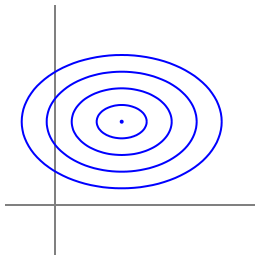
Let \(G \subseteq \C\) be a region. If the closed path \(\gg\) is \(G\)-homotopic to a point (that is, a constant path) then \(\gg\) is \(G\)-contractible, and we write \(\gg\sim_G0\text{.}\) (See Figure 4.3.7 for an example.)
This corollary is worth meditating over. For example, you should compare it with Corollary 4.2.7: both results give a zero integral, yet they make truly opposite assumptions (one about the existence of an antiderivative, the other about the existence of a derivative).
Since \(\Log\) is holomorphic in \(G = \C \setminus \R_{ \le 0 }\) and the ellipse \(\gg\) in Figure 4.3.7 is \(G\)-contractible, Corollary 4.3.8 gives
The first integral on the right-hand side is zero by Corollary 4.3.8 applied to the function \(f(z) = \frac{ 1 }{ z-2 }\) (note that \(f\) is holomorphic in \(\C \setminus \{ 2 \}\) and \(\gg\) is \((\C \setminus
\{ 2 \})\)-contractible). The second integral is \(2 \pi i\) by Exercise 4.5.4, and so