Suppose \(f\) is holomorphic in the region \(G\) and \(\gg\) is a positively oriented, simple, closed, piecewise smooth, \(G\)-contractible path. If \(w\) is inside \(\gg\) then
The idea of our proof is very similar to that of Cauchy’s Integral Formula (Theorem 4.4.1 and Theorem 4.4.5). We will study the following difference quotient, which we rewrite using Theorem 4.4.5.
This can be made arbitrarily small if we can show that the integral on the right-hand side stays bounded as \(\D w \to
0\text{.}\) In fact, by Proposition 4.1.8(d), it suffices to show that the integrand stays bounded as \(\D w \to 0\) (because \(\gg\) and hence \(\length (\gg)\) are fixed).
Let \(M := \max_{ z \in \gg } \left| f(z) \right|\) (whose existence is guaranteed by Theorem A.0.1). Choose \(\delta > 0\) such that \(D[w,\delta] \cap \gg =
\emptyset\text{;}\) that is, \(\abs{z-w}\ge \delta\) for all \(z\) on \(\gamma\text{.}\) By the reverse triangle inequality (Corollary 1.3.5(b)), for all \(z \in \gg\text{,}\)
Theorem 5.1.1 suggests that there are similar formulas for the higher derivatives of \(f\text{.}\) This is in fact true, and theoretically we could obtain them one by one with the methods of the proof of Theorem 5.1.1. However, once we start studying power series for holomorphic functions, we will obtain such a result much more easily; so we save the derivation of integral formulas for higher derivatives of \(f\) for later (Corollary 8.1.12).
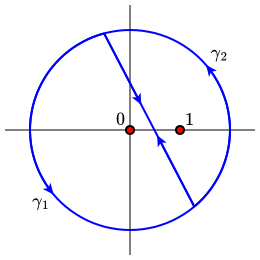
we could employ a partial fractions expansion similar to the one in Example 4.3.11, or moving the integration path similar to the one in Exercise 4.5.29. To exhibit an alternative, we split up the integration path as illustrated in Figure 5.1.4: we introduce an additional path that separates 0 and 1. If we integrate on these two new closed paths (\(\gamma_1\) and \(\gamma_2\)) counterclockwise, the two contributions along the new path will cancel each other.
The effect is that we transformed an integral for which two singularities were inside the integration path into a sum of two integrals, each of which has only one singularity inside the integration path; these new integrals we know how to deal with, using Theorem 4.4.1 and Theorem 5.1.1:
Theorem 5.1.1 has another powerful consequence: just from knowing that \(f\) is holomorphic in \(G\text{,}\) we know of the existence of \(f''\text{,}\) that is, \(f'\) is also holomorphic in \(G\). Repeating this argument for \(f'\text{,}\) then for \(f''\text{,}\)\(f'''\text{,}\) etc., shows that all derivatives \(f^{(n)}\) exist and are holomorphic. We can translate this into the language of partial derivatives, since the Cauchy–Riemann equations (Theorem 2.3.1) show that any sequence of \(n\) partial differentiations of \(f\) results in a constant times \(f^{(n)}\text{.}\)
If \(f\) is differentiable in a region \(G\) then \(f\) is infinitely differentiable in \(G\text{,}\) and all partials of \(f\) with respect to \(x\) and \(y\) exist and are continuous.