Several beautiful applications of Cauchy’s Integral Formulas (such as Theorem 4.4.5 and Theorem 5.1.1) arise from considerations of the limiting behavior of the integral as the path gets arbitrarily large. The first and most famous application concerns the roots of polynomials. As a preparation we prove the following inequality, which is generally quite useful. It says that for \(|z|\) large enough, a polynomial \(p(z)\) of degree \(d\) looks almost like a constant times \(z^d\text{.}\)
Then the sum inside the last factor has limit \(1\) as \(z\to\infty\) (by Exercise 3.6.12), and so its modulus is between \(\frac 1 2\) and \(2\) as long as \(|z|\) is large enough.
The Fundamental Theorem of Algebra was first proved by Gauß (in his doctoral dissertation in 1799, which had a flaw—later, he provided three rigorous proofs), although its statement had been assumed to be correct long before Gauß’s time. It is amusing that such an important algebraic result can be proved purely analytically. There are proofs of the Fundamental Theorem of Algebra that do not use complex analysis. On the other hand, all proofs use some analysis (such as the Intermediate Value Theorem). The Fundamental Theorem of Algebra refers to algebra in the sense that it existed in 1799, not to modern algebra. Thus one might say that the Fundamental Theorem of Algebra is neither fundamental to algebra nor even a theorem of algebra. The proof we give here is due to Anton R. Schep and appeared in the American Mathematical Monthly (January 2009).
.
Every nonconstant polynomial has a root in \(\C\text{.}\)
Suppose (by way of contradiction) that \(p\) does not have any roots, that is, \(p(z) \not= 0\) for all \(z \in \C\text{.}\) Then \(\frac 1 {p(z)}\) is entire, and so Cauchy’s Integral Formula (Theorem 4.4.1) gives
for any \(R>0\text{.}\) Let \(d\) be the degree of \(p(z)\) and \(a_d\) its leading coefficient. Proposition 4.1.8(d) and Proposition 5.3.1 allow us to estimate, for sufficiently large \(R\text{,}\)
The left-hand side is independent of \(R\text{,}\) while the right-hand side can be made arbitrarily small (by choosing \(R\) sufficiently large), and so we conclude that \(\frac 1 {p(0)} = 0\text{,}\) which is impossible.
Theorem 5.3.2 implies that any polynomial \(p\) can be factored into linear terms of the form \(z-a\) where \(a\) is a root of \(p\text{,}\) as we can apply the corollary, after getting a root \(a\text{,}\) to \(\frac{ p(z) }{z-a}\) (which is again a polynomial by the division algorithm), etc. (see also Exercise 5.4.11).
A compact reformulation of the Fundamental Theorem of Algebra (Theorem 5.3.2) is to say that \(\C\) is algebraically closed. In contrast, \(\R\) is not algebraically closed.
The polynomial \(p(x) = 2x^4+5x^2+3\) has no roots in \(\R\text{.}\) The Fundamental Theorem of Algebra (Theorem 5.3.2) states that \(p\) must have a root (in fact, four roots) in \(\C\text{:}\)
Another powerful consequence of Theorem 5.1.1 is the following result, which again has no counterpart in real analysis (consider, for example, the real sine function).
This theorem is for historical reasons erroneously attributed to Joseph Liouville (1809–1882). It was published earlier by Cauchy; in fact, Gauß may well have known about it before Cauchy.
Suppose \(|f(z)| \leq M\) for all \(z \in \C\text{.}\) Given any \(w \in \C\text{,}\) we apply Theorem 5.1.1 with the circle \(C[w,R]\text{;}\) note that we can choose any \(R>0\) because \(f\) is entire. By Proposition 4.1.8(d),
The right-hand side can be made arbitrarily small, as we are allowed to choose \(R\) as large as we want. This implies that \(f'=0\text{,}\) and hence, by Theorem 2.4.2, \(f\) is constant.
As an example of the usefulness of Liouville’s theorem (Corollary 5.3.4), we give another proof of the Fundamental Theorem of Algebra, close to Gauß’s original proof.
Suppose (by way of contradiction) that \(p\) does not have any roots, that is, \(p(z) \not= 0\) for all \(z \in \C\text{.}\) Thus the function \(f(z) = \frac 1 {p(z)}\) is entire. But \(f \to 0\) as \(|z| \to \infty\text{,}\) by Proposition 5.3.1; consequently, by Exercise 5.4.10, \(f\) is bounded. Now we apply Corollary 5.3.4 to deduce that \(f\) is constant. Hence \(p\) is constant, which contradicts our assumptions.
As one more example of the theme of getting results from Cauchy’s Integral Formulas by taking the limit as a path “goes to infinity,” we compute an improper integral.
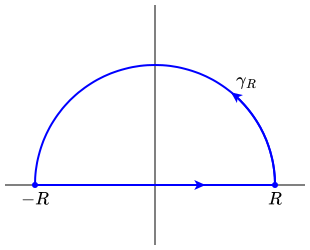
Let \(\sigma_R\) be the counterclockwise semicircle formed by the segment \([-R,R]\) of the real axis from \(-R\) to \(R\text{,}\) followed by the circular arc \(\gg_R\) of radius \(R\) in the upper half plane from \(R\) to \(-R\text{,}\) where \(R>1\text{;}\) see Figure 5.3.6.
This holds for any \(R>1\text{,}\) and so we can take the limit as \(R\to\infty\text{.}\) By Proposition 4.1.8(d) and the reverse triangle inequality (Corollary 1.3.5(b)),
Of course this integral can be evaluated almost as easily using standard formulas from calculus. However, just slight modifications of this example lead to improper integrals that are beyond the scope of basic calculus; see Exercise 5.4.18 and Exercise 5.4.19.