Exercise 2.5.16 said that any polynomial in \(z\) is an entire function, and so the linear fractional transformation \(f(z) = \frac{ az+b }{ cz+d }\) is holomorphic in \(\C
\setminus \{ - \frac d c \}\text{,}\) unless \(c=0\) (in which case \(f\) is entire). If \(c \ne 0\) then \(\frac{ az+b }{ cz+d } = \frac a c\) implies \(ad-bc = 0\text{,}\) which means that a Möbius transformation \(f(z) = \frac{ az+b }{ cz+d }\) will never take on the value \(\frac a c\text{.}\) Our first proposition in this chapter says that with these small observations about the domain and image of a Möbius transformation, we obtain a class of bijections, which are quite special among complex functions.
Let \(a,b,c,d \in \C\) with \(c \ne 0\text{.}\) Then \(f: \C
\setminus \{ - \frac d c \} \to \C \setminus \{ \frac a c
\}\) given by \(f(z) = \frac{ az+b }{ cz+d }\) has the inverse function \(f^{-1}: \C \setminus \{ \frac a c \} \to
\C \setminus \{ - \frac d c \}\) given by
We remark that the formula for \(f^{-1} (z)\) in Proposition 3.1.2 works also when \(c = 0\text{,}\) except that in this case both domain and image of \(f\) are \(\C\text{;}\) see Exercise 3.6.2. In either case, we note that the inverse of a Möbius transformation is another Möbius transformation.
Consider the linear fractional transformation \(f(z) = \frac{
z-1 }{ iz+i }\text{.}\) This is a Möbius transformation (check the condition!) with domain \(\C \setminus \{ -1
\}\) whose inverse can be computed via
Exercise 3.6.1 verifies that the Möbius transformation \(g(z) = \frac{ dz-b }{ -cz+a }\) is the inverse of \(f\text{,}\) and by what we have just proved, \(g\) is also one-to-one. But this implies that \(f: \C \setminus \{ - \frac d c \} \to
\C \setminus \{ \frac a c \}\) is onto.
Möbius transformations have even more fascinating geometric properties. En route to an example of such, we introduce some terminology. Special cases of Möbius transformations are translations\(f(z) = z + b\text{,}\)dilations\(f(z) = az\text{,}\) and inversion\(f(z) = \frac 1 z\text{.}\) The next result says that if we understand these three special Möbius transformations, we understand them all.
Translations and dilations certainly map circles and lines into circles and lines, so by Proposition 3.1.4, we only have to prove the statement of the theorem for the inversion \(f(z) = \frac 1 z\text{.}\)
The equation for a circle centered at \(x_0 + iy_0\) with radius \(r\) is \((x-x_0)^2 + (y-y_0)^2 = r^2\text{,}\) which we can transform to
\begin{equation}
\alpha (x^2 + y^2) + \beta x + \gamma y + \delta \ = \ 0\tag{3.1}
\end{equation}
for some real numbers \(\alpha\text{,}\)\(\beta\text{,}\)\(\gamma\text{,}\) and \(\delta\) that satisfy \(\beta^2 + \gamma^2 > 4 \,
\alpha \delta\) (see Exercise 3.6.3). The form (3.1) is more convenient for us, because it includes the possibility that the equation describes a line (precisely when \(\alpha = 0\)).
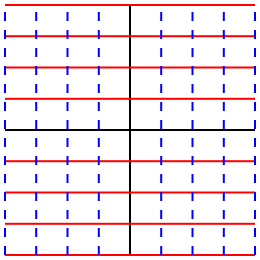
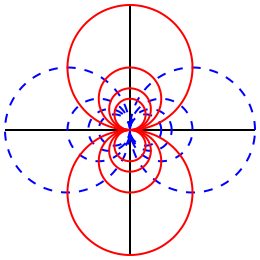
Figure 3.1.7 demonstrates the effect that the inversion \(f(z)=\frac1z\) has on horizontal and vertical lines. In particular, the vertical line defined by \(\Re(z)=x_0\) is mapped into the circle of radius \(\frac1{2x_0}\) centered at \(\left(\frac1{2x_0},0\right)\text{.}\)
Figure3.1.7.Inversion maps vertical lines, shown on the left, into the circles centered on the real axis. Horizontal lines are mapped into circles centered on the imaginary axis.