Skip to main content
Contents Index Dark Mode Prev Up Next \(\def\versionnumber{1.54}
\def\JPicScale{0.7}
\def\versionyear{2018}
\def\JPicScale{0.7}
\def\versionmonth{July \versionyear}
\def\JPicScale{0.7}
\def\JPicScale{0.7}
\newcommand{\ix}[1]{#1\index{#1}}
\def\JPicScale{0.7}
\newcommand{\Z}{\mathbb{Z}}
\def\JPicScale{0.7}
\newcommand{\Q}{\mathbb{Q}}
\def\JPicScale{0.6}
\newcommand{\R}{\mathbb{R}}
\def\JPicScale{0.6}
\newcommand{\C}{\mathbb{C}}
\def\s{\sum_{k \geq 0}}
\newcommand{\N}{\mathbb{N}}
\def\sz{\sum_{ k \in \Z }}
\newcommand{\Chat}{\hat\C}
\def\JPicScale{0.7}
\newcommand{\Rhat}{\hat\R}
\def\i{\int_\gg}
\newcommand{\gd}{\delta}
\def\JPicScale{0.7}
\renewcommand{\gg}{\gamma}
\newcommand{\D}{\Delta}
\newcommand{\Dp}{\check{D}}
\DeclareMathOperator{\length}{length}
\DeclareMathOperator{\dist}{dist}
\DeclareMathOperator{\fLog}{\mathcal{L}\!og}
\DeclareMathOperator{\fArg}{\mathcal{A}rg}
\DeclareMathOperator{\Log}{Log}
\DeclareMathOperator{\Arg}{Arg}
\let\Im\relax
\let\Re\relax
\DeclareMathOperator{\Im}{Im}
\DeclareMathOperator{\Re}{Re}
\def\sz{\sum_{ k \in \Z }}
\def\s{\sum_{k \geq 0}}
\DeclareMathOperator{\Res}{Res}
\renewcommand{\emptyset}{\varnothing}
\newcommand{\Def}[1]{\textbf{#1}}
\newcommand{\hint}[1]{(\emph{Hint}: #1)}
\newcommand{\histremark}[1]{}
\newcommand{\histremarktwo}[2]{}
\newcommand{\listset}[1]{\left\{#1\right\}}
\newcommand{\makeset}[2]{\listset{#1\colon\,#2}}
\newcommand{\listseq}[1]{\left\langle#1\right\rangle}
\newcommand{\makeseq}[2]{\listseq{#1\colon\,#2}}
\newcommand{\ds}{\displaystyle}
\newcommand{\conj}[1]{\overline{#1}}
\newcommand{\abs}[1]{\left|#1\right|}
\newcommand{\zbar}{\overline{z}}
\def\o{\overline}
\newcommand{\fderiv}[2]{\frac{\partial #1}{\partial #2}}
\newcommand{\sderiv}[2]{\frac{\partial^2 #1}{\partial #2^2}}
\newcommand{\mderiv}[3]{\frac{\partial^2 #1}{\partial #2 \, \partial #3}}
\newcommand{\mat}[1]{\displaystyle\begin{bmatrix} #1 \end{bmatrix}}
\newcommand{\disp}[1]{$\displaystyle#1$}
\renewcommand{\th}{^{ th}}
\newcommand{\boldcdot}{\boldsymbol{\cdot}}
\newcommand{\diff}[1]{{d#1}}
\newcommand{\itref}[1]{\eqref{#1}}
\def\newnotes{
\begin{remarks}
\thenotes.
}
\def\writenote{
\vspace{10pt} \thenotes.
}
\newcommand{\putqed}{\pushQED{\qed}\popQED}
\newcommand{\lt}{<}
\newcommand{\gt}{>}
\newcommand{\amp}{&}
\newcommand{\fillinmath}[1]{\mathchoice{\underline{\displaystyle \phantom{\ \,#1\ \,}}}{\underline{\textstyle \phantom{\ \,#1\ \,}}}{\underline{\scriptstyle \phantom{\ \,#1\ \,}}}{\underline{\scriptscriptstyle\phantom{\ \,#1\ \,}}}}
\)
Section 1.3 Geometric Properties
From the chain of basic inequalities
\begin{equation*}
- \sqrt{ x^2 + y^2 } \le - \sqrt{ x^2 } \le x \le \sqrt{ x^2 }
\le \sqrt{ x^2 + y^2 }
\end{equation*}
(or, alternatively, by arguing with basic geometric properties of triangles), we obtain the inequalities
\begin{equation}
-|z| \ \leq \ \Re(z) \ \leq \ |z| \qquad \text{ and } \qquad
-|z| \ \leq \ \Im(z) \ \leq \ |z| \, \text{.}\tag{1.16}
\end{equation}
The square of the absolute value has the nice property
\begin{equation*}
\left| x+iy \right|^2 \ = \ x^2 + y^2 \ = \ (x+iy) (x-iy) \,\text{.}
\end{equation*}
This is one of many reasons to give the process of passing from
\(x+iy\) to
\(x-iy\) a special name.
Definition 1.3.1 .
The number \(x-iy\) is the (complex) conjugate of \(x+iy\text{.}\) We denote the conjugate by
\begin{equation*}
\overline{x+iy} \ := \ x-iy \,\text{.}
\end{equation*}
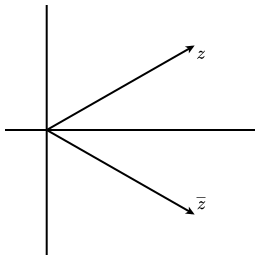
Geometrically, conjugating
\(z\) means reflecting the vector corresponding to
\(z\) with respect to the real axis, as shown in
Figure 1.3.2 .
Figure 1.3.2. The complex conjugate \(\conj{z}\) is obtained by reflecting \(z\) across the real axis. The following proposition collects some basic properties of the conjugate.
Proposition 1.3.3 .
For any \(z, z_1, z_2 \in \C\text{,}\)
\(\displaystyle \conj{z_1 \pm z_2} = \conj{z_1}\pm\conj{z_2}\)
\(\displaystyle \conj{z_1 \cdot z_2} = \conj{z_1}\cdot\conj{z_2}\)
\(\displaystyle \conj{ \left( \frac{ z_1 }{ z_2 } \right) } = \frac{
\ \conj{z_1} \ }{ \conj{z_2} }\)
\(\displaystyle \conj{\, \conj{z} \, }=z\)
\(\displaystyle \abs{\conj{z}}=\abs z\)
\(\displaystyle \abs{z}^2=z\conj z\)
\(\displaystyle \Re(z) = \frac 1 2 \left( z+\conj z \right)\)
\(\displaystyle \Im(z) = \frac{ 1 }{ 2i } \left( z-\conj z \right)\)
\(\conj{e^{i\phi}}=e^{-i\phi}\text{.}\)
The proofs of these properties are straightforward (see
Exercise 1.5.22 ); once more we give a sample (b).
Proof.
Let \(z_1 = x_1 + i y_1\) and \(z_2 = x_2 + i y_2\text{.}\) Then
\begin{align*}
\conj{z_1 \cdot z_2} \amp \ = \ \conj{ (x_1 x_2 - y_1 y_2)
+ i ( x_1 y_2 + x_2 y_1 ) }\\
\amp \ = \ (x_1 x_2 - y_1 y_2) - i ( x_1 y_2 + x_2 y_1 )\\
\amp \ = \ (x_1 - i y_1) (x_2 - i y_2)\\
\amp \ = \ \conj{z_1}\cdot\conj{z_2} \, .
\end{align*}
We note that the property
\(\abs{z}^2=z\conj z\) yields a neat formula for the inverse of a nonzero complex number, which is implicit already in
(1.14) :
\begin{equation*}
z^{-1} \ = \ \frac1z \ = \ \frac{\conj z}{\abs{z}^2} \,\text{.}
\end{equation*}
A famous geometric inequality (which holds, more generally, for vectors in
\(\R^n\) ) goes as follows.
Proposition 1.3.4 . Triangle inequality.
For any
\(z_1, z_2 \in \C\) we have
\(\ds \left| z_1 + z_2 \right| \leq \left| z_1 \right| + \left| z_2 \right| \text{.}\)
By drawing a picture in the complex plane, you should be able to come up with a geometric proof of the triangle inequality. Here we proceed algebraically:
Proof.
\begin{align*}
\left| z_1 + z_2 \right|^2 \ \amp = \ \left( z_1 + z_2
\right) \o{ \left( z_1 + z_2 \right) }\\
\amp = \ \left( z_1 + z_2
\right) \left( \o{z_1} + \o{z_2} \right)\\
\amp = \ z_1 \o{z_1} + z_1
\o{z_2} + z_2 \o{z_1} + z_2 \o{z_2}\\
\amp = \ \left| z_1 \right|^2 + z_1 \o{z_2} + \o{ z_1 \o{z_2}
} + \left| z_2 \right|^2\\
\amp = \ \left| z_1 \right|^2 + 2 \Re
\left( z_1 \o{z_2} \right) + \left| z_2 \right|^2\\
\amp \leq \ \left| z_1 \right|^2 + 2 \left| z_1 \o{z_2}
\right| + \left| z_2 \right|^2\\
\amp = \ \left| z_1 \right|^2 + 2
\left| z_1 \right| \left| \o{z_2} \right| + \left| z_2
\right|^2\\
\amp = \ \left| z_1 \right|^2 + 2 \left| z_1 \right|
\left| z_2 \right| + \left| z_2 \right|^2\\
\amp = \ \left( \left| z_1 \right| + \left| z_2 \right|
\right)^2\text{,}
\end{align*}
where the inequality follows from
(1.16) . Taking square roots on the left- and right-hand sides proves our claim.
For future reference we list several useful variants of the triangle inequality:
Corollary 1.3.5 .
For \(z_1, z_2, \dots, z_n \in \C\text{,}\) we have the following relations:
The triangle inequality:
\begin{equation*}
\abs{\pm z_1\pm z_2} \le
\abs{z_1}+\abs{z_2} \,\text{.}
\end{equation*}
The reverse triangle inequality:
\begin{equation*}
\abs{\pm z_1\pm z_2} \ge \bigl|
\abs{z_1}-\abs{z_2} \bigr| \,\text{.}
\end{equation*}
The triangle inequality for sums:
\begin{equation*}
\abs{\sum_{k=1}^n z_k} \ \le \ \sum_{k=1}^n \abs{z_k} \, \text{.}
\end{equation*}
The first item (
a ) is just a rewrite of the original triangle inequality, using the fact that
\(\abs{\pm z}=\abs{z}\text{,}\) and (
c ) follows by induction. The proof of the reverse triangle inequality is left as
Exercise 1.5.25 .