A series is a sequence \(\left( a_n \right)\) whose members are of the form \(a_n = \sum_{k=1}^n b_k\) (or \(a_n = \sum_{k=0}^n b_k\)); we call \(\left( b_k \right)\) the sequence of terms of the series. The \(a_n = \sum_{k=1}^n b_k\) (or \(a_n = \sum_{k=0}^n b_k\)) are the partial sums of the series.
If we wanted to be lazy we would define convergence of a series simply by referring to convergence of the partial sums of the series—after all, we just defined series through sequences. However, there are some convergence features that take on special appearances for series, so we mention them here explicitly. For starters, a series converges to the limit (or sum) \(L\) by definition if
To prove that a series converges we use the definition of limit of a sequence: for any \(\epsilon > 0\) we have to find an \(N\) such that for all \(n \geq N\text{,}\)
Most of the time we can use the completeness property to check convergence of a series, and it is fortunate that the Monotone Sequence Property has a convenient translation into the language of series of real numbers. The partial sums of a series form a nondecreasing sequence if the terms of the series are nonnegative, and this observation immediately yields the following:
Although Corollary 7.2.4 is a mere direct consequence of the completeness property of \(\R\text{,}\) it is surprisingly useful. Here is one application, sometimes called the Comparison Test:
Continuing Example 7.2.2, for \(|z| \ge 1\) the geometric series \(\sum_{ k \ge 1 } z^k\) diverges since in this case \(\lim_{ n \to \infty } z^n\) either does not exist or is not 0.
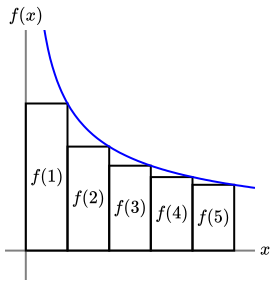
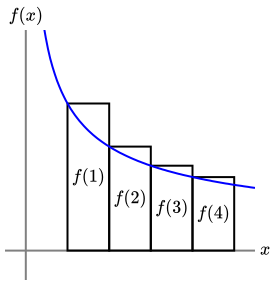
The Integral Test literally comes with a proof by picture—see Figure 7.2.12: the integral of \(f\) on the interval \([k,k+1]\) is bounded between \(f(k)\) and \(f(k+1)\text{.}\) Adding the pieces gives the inequalities above for the \(n\)th partial sum versus the integrals from \(1\) to \(n\) and from \(1\) to \(n+1\text{,}\) and the inequality persists in the limit.
If \(f: [1,\infty) \to \R_{ \ge 0 }\) is continuous and nonincreasing, then \(\sum_{k \ge 1} f(k)\) converges if and only if \(\int_1^\infty f(t)\,\diff{t}\) is finite.
Suppose \(\int_1^\infty f(t)\,\diff{t} = \infty\text{.}\) Then the first inequality in Proposition 7.2.11 implies that the partial sums \(\sum_{k=1}^n f(k)\) are unbounded, and so Corollary 7.2.4 says that \(\sum_{k \ge 1} f(k)\) cannot converge.
Conversely, if \(\int_1^\infty f(t)\,\diff{t}\) is finite then the second inequality in Proposition 7.2.11 says that the partial sums \(\sum_{k=1}^n f(k)\) are bounded; thus, again with Corollary 7.2.4, we conclude that \(\sum_{k \ge 1} f(k)\) converges.
The series \(\sum_{k\ge1} \frac 1 {k^p}\) converges for \(p > 1\) and diverges for \(p \lt 1\) (and the case \(p=1\) was the subject of Example 7.2.10) because
By now you might be amused that we have collected several results on series whose terms are nonnegative real numbers. One reason is that such series are a bit easier to handle, another one is that there is a notion of convergence special to series that relates any series to one with only nonnegative terms:
For the general case \(b_k \in \C\text{,}\) we write each term as \(b_k = c_k + i \, d_k\text{.}\) Since \(0 \le |c_k| \le |b_k|\) for all \(k \ge 1\text{,}\)Corollary 7.2.6 implies that \(\sum_{ k \ge 1 } c_k\) converges absolutely, and by an analogous argument, so does \(\sum_{ k \ge 1 } d_k\text{.}\) But now we can use the first case to deduce that both \(\sum_{
k \ge 1 } c_k\) and \(\sum_{ k \ge 1 } d_k\) converge, and thus so does
\begin{equation*}
\sum_{ k \ge 1 } b_k \ = \ \sum_{ k \ge 1 } c_k + i \sum_{ k \ge
1 } d_k \, \text{.}
\end{equation*}
converges. Viewed as a function in \(z\text{,}\) the series \(\zeta(z)\) is the Riemann zeta function, an indispensable tool in number theory and many other areas in mathematics and physics. 1
The Riemann zeta function is the subject of the arguably most famous open problem in mathematics, the Riemann hypothesis. It turns out that \(\zeta(z)\) can be extended to a function that is holomorphic on \(\C \setminus \{ 1 \}\text{,}\) and the Riemann hypothesis asserts that the roots of this extended function in the strip \(0 \lt \Re(z) \lt 1\) are all on the critical line\(\Re(z) = \frac 1 2\text{.}\)
(There is a small technical detail to be checked here, since we are effectively ignoring half the partial sums of the original series; see Exercise 7.5.16.) Since